


Hyperhidrosis Treatment in Bucharest: Medical Solutions for Excessive Sweating
Medical control of excessive sweating by injection with botulinum toxin type A: minimally invasive, locally targeted and performed by dermatologists in the Skina clinic.
What is hyperhidrosis and how is it medically classified?
Hyperhidrosis is a chronic dermatological condition characterized by excessive and unpredictable sweat production, exceeding the body's physiological thermoregulatory needs. The condition is clinically classified into primary hyperhidrosis (idiopathic, localized) and secondary hyperhidrosis (generalized, caused by underlying pathologies).
Hyperhidrosis is a dysfunction of the eccrine sweat glands, caused by an increased activity of the sympathetic nervous system. This manifestation occurs independently of increased ambient temperatures, the patient's emotional state or the level of physical exertion.
To establish a correct therapeutic protocol, our dermatologists perform a rigorous differential diagnosis between the two main forms:
Primary (Focal) Hyperhidrosis
Localized form, with frequent onset in adolescence and a strong genetic component. Affects specific body areas (usually the armpits, palms or soles), without being triggered by another disease.
Secondary (Generalized) Hyperhidrosis
It affects large areas of the body and appears as a secondary symptom of systemic conditions (endocrine disorders, thyroid dysfunction, diabetes mellitus, hormonal changes associated with menopause) or as an adverse reaction to certain drug therapies.
Severity assessment: HDSS scale (Hyperhidrosis Disease Severity Scale)
The HDSS scale is a diagnostic tool for assessing the severity of primary hyperhidrosis. This score directly measures the impact of excessive sweating on daily activities, guiding the appropriateness and personalization of injectable medical treatment.
During the dermatological consultation in Bucharest, the objective assessment of the severity of sweating allows the condition to be classified according to the degree of disruption to the patient's quality of life:
- Score 1 (Mild): The sweating is not noticeable and does not affect daily activities in any way. It does not require medical treatment.
- Score 2 (Moderate): Sweating is tolerable, but causes occasional limitations in routine actions.
- Score 3 (Severe): Sweating is difficult to tolerate and frequently disrupts daily activities (choosing clothes, social or professional interactions). Clear indication for treatment.
- Score 4 (Severe): Sweating is completely intolerable and constantly blocks daily activities. Priority indication for treatment.
Anatomical areas addressed in our clinic
Medical management of focal hyperhidrosis focuses on the three areas with the highest density of eccrine sweat glands: axillary, palmar, and plantar. Each region benefits from individualized injection protocols tailored to skin thickness and local sensitivity.
Depending on the location of the discomfort, we invite you to explore our dedicated pages for detailed protocols, logistical measures and specific developments:
Axillary Hyperhidrosis
Excessive sweating in the armpits causes visible stains on clothing and the risk of bromhidrosis (bad odor). It is the area with the longest duration of maintenance of the therapeutic effect.
Learn more about axillary treatment →Palmar Hyperhidrosis
Permanently wet or cold palms affect social interactions (handshakes) and professional activities (touch screens, handling tools or documents).
Learn more about palmar treatment →Plantar Hyperhidrosis
Constant moisture on the soles causes maceration of the stratum corneum, slipping in shoes, and an increased risk of bacterial or fungal infections (athlete's foot).
Learn more about plantar treatment →How do we manage excessive sweating? Treatment available at Skina Clinic
Clinical guidelines list various methods for controlling hyperhidrosis, from aluminum-containing antiperspirants to surgical sympathectomy. Our clinic in Bucharest has specialized in injectable botulinum toxin treatment, considered the gold standard for effectiveness and safety.
Although the medical literature describes multiple management options, such as iontophoresis or surgical sympathectomy (often associated with the risk of severe compensatory hyperhidrosis on the back or abdomen), our medical team has chosen to offer exclusively injectable therapy with botulinum toxin type A. This strict clinical specialization is based on major therapeutic advantages:
- Minimally invasive approach: The procedure is performed in the office, does not require incisions, hospitalization or complex recovery periods.
- Locally targeted efficiency: The substance exclusively inhibits the sweat glands in the mapped anatomical area, leaving the thermoregulation process intact in the rest of the body.
- High safety profile: We only use premium, approved products, administered by dermatologists trained in advanced intradermal injection techniques.
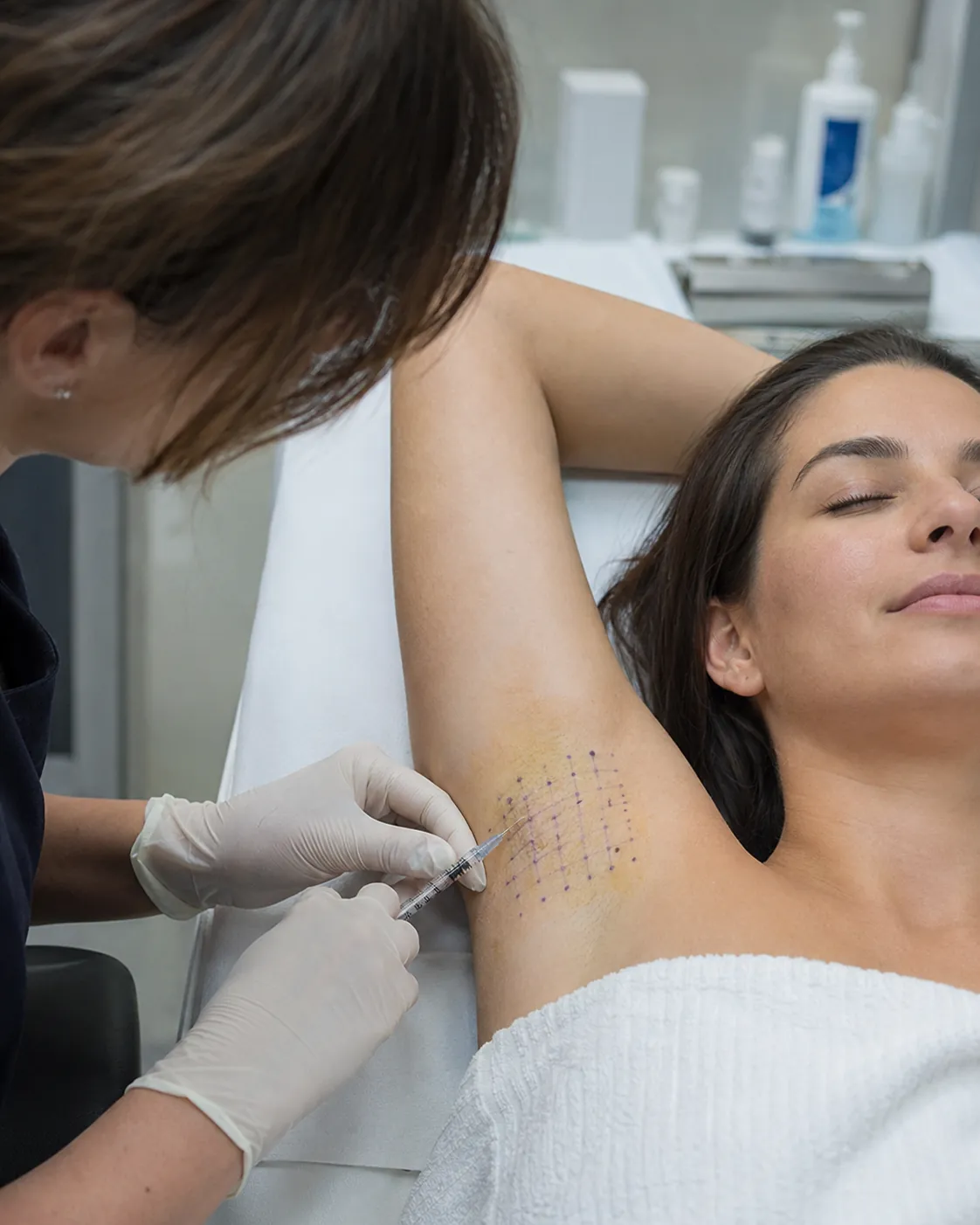
Mechanism of action: How does botulinum toxin work?
Botulinum toxin treatment for hyperhidrosis works by temporarily and reversibly blocking the release of acetylcholine, the neurotransmitter that stimulates sweat secretion. By interrupting this local chemical stimulus, the activity of the eccrine glands is stopped, ensuring that the skin in the treated area dries out.
The substance injected intradermally acts strictly at the neuroglandular junction in the superficial layers of the skin. It does not affect vascular structures, sensory nerves (tactile sensitivity remains intact), or regional lymph nodes.
Essential deontological statement
The effect of this medical procedure is temporary and reversible. As the body naturally regenerates new nerve endings, the activity of the sweat glands will gradually resume. The duration of clinical benefits varies between 4 and 9 months, being directly influenced by the treated area (the axillary region shows a longer remission than the palmar or plantar regions, due to different mechanical dynamics) and by the individual metabolism. To maintain control, it is recommended to repeat the treatment periodically.
Patient Safety: Contraindications and Possible Side Effects
Safety in injectable treatment for hyperhidrosis requires a rigorous evaluation of medical history. The procedure is contraindicated in pregnancy, breastfeeding and neuromuscular diseases, and the possible side effects are local, transient and completely reversible within a few days.
At Skina Bucharest, the medical act is carried out under strict conditions of asepsis and sterility. During the initial consultation, our doctors rigorously exclude absolute contraindications:
- Pregnancy and breastfeeding.
- Neuromuscular transmission diseases (e.g. Myasthenia Gravis, Eaton-Lambert Syndrome).
- Bacterial, fungal infections or acute inflammations on the skin area targeted by the injection.
- Known hypersensitivity to botulinum toxin type A or to the excipients of the product.
Possible side effects: are localized and transient in nature. They may include temporary erythema (redness), discrete edema, or small ecchymoses (bruises) at the injection sites, which resolve spontaneously within a few days. In the case of palmar injection, some patients may experience a slight temporary decrease in fine finger grip strength, an effect reversible within 2-3 weeks.
What are the factors that determine the cost of treatment?
The cost of medical treatment for hyperhidrosis reflects the volume of botulinum toxin required to effectively block the sweat glands. Our clinic in Bucharest applies premium protocols and substances, using full doses of 100 units to ensure uniformity and durability of results.
- Quantity of substance (number of units): To achieve effective sweat control and prevent the appearance of "islands" of moisture, our standard protocols allocate a full dose of 100 units to each bilateral area treated (armpits, palms or soles).
- Specialist's expertise: Precise intradermal injection requires advanced technique to ensure optimal distribution of the substance without affecting adjacent muscle structures.
To view the updated list of our rates and consultation costs, please visit the pricing page.
Frequently asked questions about excessive sweating
How long after the injection will I notice that I no longer sweat?
The decrease in sweat secretion begins to be felt by the patient 2-4 days after the procedure. The maximum therapeutic effect, characterized by uniform drying of the treated area, is fully established within 10-14 days post-injection.
Is the procedure painful? What comfort techniques do you use?
Discomfort is variable and depends on the sensitivity threshold of each person. The axillary area is very easily tolerated, while the palms and soles have greater sensitivity. In our clinic we apply an advanced pain management scheme, combining deep-acting anesthetic creams under occlusion and cryotherapy systems (intense local cooling) during the injection.
Where does sweat go if we block an area of the body?
From a physiological point of view, sweating is not blocked inside the body, but its production is simply stopped locally at the treated glands. The natural process of global thermoregulation is not affected, the excess heat being eliminated normally through the rest of the body's skin surface.
Scientific resources and international clinical guidelines
The scientific basis of our hyperhidrosis treatment protocols is based on indexed international clinical guidelines. Studies in databases such as PubMed and Cochrane attest to the safety of injectable treatment and the remarkable improvement in patients' quality of life.
- Global consensus guideline for the management of focal hyperhidrosis (Dermatologic Surgery Journal): pubmed.ncbi.nlm.nih.gov/17661933
- Pharmacological evaluation and quality of life impact (Cochrane/Oxford Academic): academic.oup.com/bjd
Schedule a specialist consultation
To establish a correct diagnosis and eliminate secondary causes, our team of dermatologists awaits you at the Skina clinic in Bucharest.
Article written in accordance with current medical guidelines and reviewed by the team of dermatologists at Skina Bucharest Clinic. The information is purely educational and does not replace clinical evaluation in the office.